
Clean drinking water is no longer a luxury—it has become a basic necessity. With increasing pollution, high TDS levels, and contamination in groundwater and municipal supply, using a water purifier at home is essential. But many people still ask an important question: how does water purifier work?
Understanding the working process of a water purifier helps you choose the right system for your home and ensures your family drinks safe, healthy water every day. In this detailed guide, we will explain how does water purifier work step by step, the water purification working model, the RO water purifier working process, and the types of water filter for home use—all in simple, easy-to-understand language.
Why Do We Need a Water Purifier Today?
Water from borewells, tankers, and even municipal supply may look clean, but it often contains invisible impurities such as:
- Harmful bacteria and viruses
- Excess TDS (Total Dissolved Solids)
- Heavy metals like lead, arsenic, and mercury
- Chlorine, pesticides, and chemical residues
These contaminants can cause stomach infections, weak immunity, kidney problems, and long-term health issues—especially in children and elderly people. That is why knowing how does water purifier work is important before making a buying decision.
What Is a Water Purifier?
A water purifier is a device that cleans water by removing physical, chemical, and biological impurities, making it safe for drinking. Unlike boiling or cloth filtering, modern water purifiers use advanced filtration technologies to remove even microscopic contaminants.
In simple words, what is a water purifier:
- Filters dirty water
- Removes germs and harmful substances
- Improves taste and odor
- Provides safe drinking water
To understand this better, let us look at the water purification working model explanation.
How Does Water Purifier Work? (Basic Working Principle)
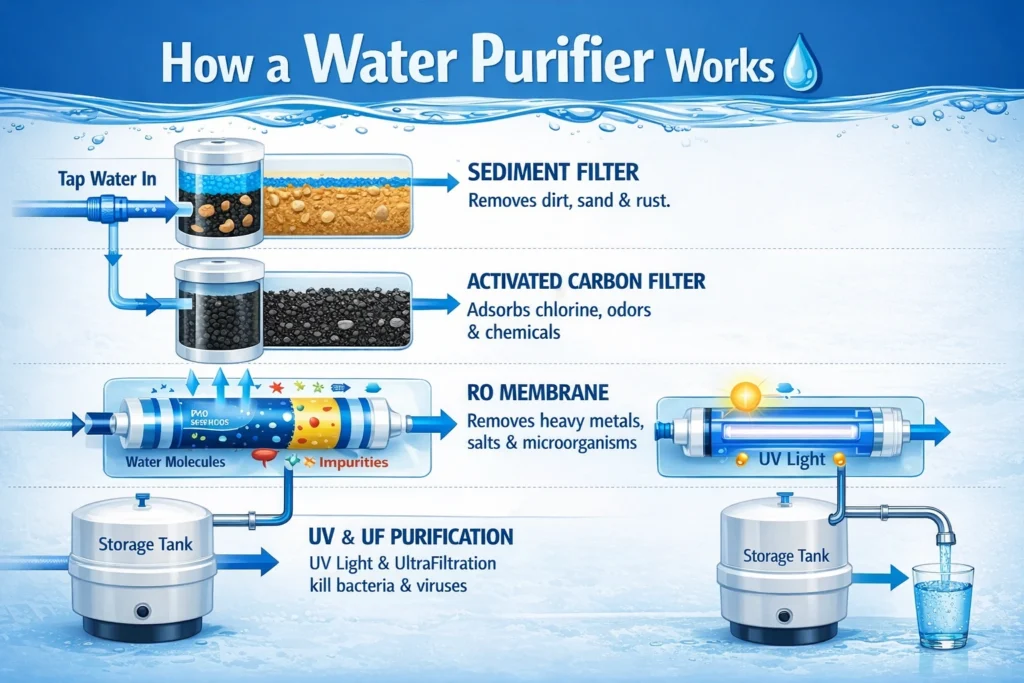
The basic principle behind water purification is multi-stage filtration. Water passes through different filters and purification stages, and each stage removes a specific type of impurity.
Overall flow:
Inlet Water → Pre-Filtration → Advanced Purification (RO/UV/UF) → Post Filtration → Storage → Drinking Water
Now let us understand how does water purifier work step by step.
Water Purification Working Model: Step-by-Step Explanation
Step 1: Pre-Filtration (Sediment Filter)
This is the first stage in almost every water purifier.
What it does:
- Removes visible impurities like dust, sand, mud, and rust
- Protects internal filters from clogging
Although it may seem basic, this step is very important because it increases the life of other filters.
Step 2: Carbon Filtration (Activated Carbon Filter)
Next, water passes through an activated carbon filter.
Role of carbon filter:
- Removes chlorine and bad odor
- Improves taste of water
- Eliminates organic chemicals and pesticides
This stage makes water more pleasant to drink and prepares it for deeper purification.
Step 3: RO Water Purifier Working Process (Most Important Stage)
This is the heart of an RO water purifier.
RO (Reverse Osmosis) technology works using:
- A semi-permeable membrane
- High water pressure
What RO removes:
- High TDS
- Dissolved salts
- Heavy metals
- Bacteria and viruses
- Fluoride, arsenic, and nitrates
In this stage, water molecules pass through the RO membrane, while impurities are flushed out as wastewater. This is why RO is highly recommended for areas with high TDS water.
This step clearly explains the RO water purifier working process in a practical way.
Step 4: UV or UF Purification (Additional Safety Layer)
Many modern purifiers include UV or UF technology along with RO.
UV (Ultraviolet) Purification:
- Uses UV light to kill bacteria and viruses
- Does not change taste or TDS
- Best for biological contamination
UF (Ultrafiltration):
- Uses hollow fiber membranes
- Removes bacteria and cysts
- Works without electricity
This stage ensures 100% germ protection, especially in municipal water supply areas.
Step 5: Post-Carbon Filter / Taste Enhancer
After RO purification, water may taste slightly flat. This stage corrects that.
Functions:
- Enhances taste
- Removes any remaining odor
- Balances minerals for better drinking experience
Some purifiers also add alkaline or copper filters at this stage for additional health benefits.
Step 6: Storage Tank and Auto Shut-Off System
Purified water is stored in a food-grade storage tank.
Additional features:
- Auto shut-off valve stops water flow when the tank is full
- Prevents water wastage
- Keeps water hygienic and ready to drink
This completes the full answer to how does water purifier work step by step.
How Do Water Filters Work?
Many people confuse water filters with water purifiers.
How do water filters work simple?
- They use basic filtration (carbon or sediment)
- Remove visible impurities, chlorine, and odor
- Do NOT remove dissolved salts or heavy metals
Water filters are suitable only when:
- TDS is low
- Water supply is already treated
- There is no heavy contamination
For high-risk water sources, RO water purifiers are a safer option.
Types of Water Filter for Home Use
Choosing the right purifier depends on your water source and quality. Let us look at the types of water filter for home use.
1. RO Water Purifier
- Best for borewell and tanker water
- Removes high TDS and heavy metals
- Ideal for most Indian households
2. UV Water Purifier
- Suitable for low-TDS water
- Kills bacteria and viruses
- Requires electricity
3. UF Water Filter
- No electricity required
- Works well with municipal water
- Does not remove dissolved salts
4. Gravity-Based Water Filter
- Budget-friendly
- No electricity
- Basic filtration only
5. RO + UV + UF Combination
- Complete protection solution
- Works with all water sources
- Most advanced and reliable option
How to Choose the Right Water Purifier for Your Home?
Before buying, consider these factors:
✔ Water Source
- Borewell or tanker → RO required
- Municipal supply → UV/UF may be enough
✔ TDS Level
- Below 300 → UV/UF
- Above 500 → RO mandatory
✔ Family Size
- Small family → 7–8 L storage
- Large family → 10–12 L storage
Benefits of Using a Water Purifier at Home
- Safe and healthy drinking water
- Protection from waterborne diseases
- Better digestion and immunity
- Saves money on bottled water
- Environment-friendly choice
Once you understand how does water purifier work, these benefits become even more meaningful.
Common Myths About Water Purifiers
Myth 1: RO Removes All Minerals
Truth: Modern RO purifiers retain essential minerals or add them back.
Myth 2: Boiling Water Is Enough
Truth: Boiling kills germs but does not remove chemicals or TDS.
Myth 3: All Water Purifiers Work the Same
Truth: Different technologies work differently based on water quality.
Maintenance Tips for Better Performance
- Replace sediment and carbon filters on time
- Service RO membrane as recommended
- Clean storage tank regularly
- Use genuine spare parts
Proper maintenance ensures your purifier works efficiently for years.
Conclusion: Clean Water Begins with the Right Knowledge
Now that you clearly understand how does water purifier work, it becomes easier to choose the right purification system for your home. From basic filtration to advanced RO technology, every stage plays an important role in delivering safe drinking water.
Investing in a good water purifier is not just about convenience—it is about protecting your family’s health every single day.
Frequently Asked Questions (FAQ)
Q1. How does a water purifier work step by step?
It filters water through sediment, carbon, RO/UV/UF stages and stores purified water safely.
Q2. Is RO water safe for daily drinking?
Yes, when minerals are balanced properly.
Q3. Which water filter is best for home use?
RO + UV + UF is the best option for Indian conditions.
Q4. How often should filters be changed?
Usually every 6–12 months, depending on usage and water quality.
Pingback: How does water purifier work? step by step best guide in 2026